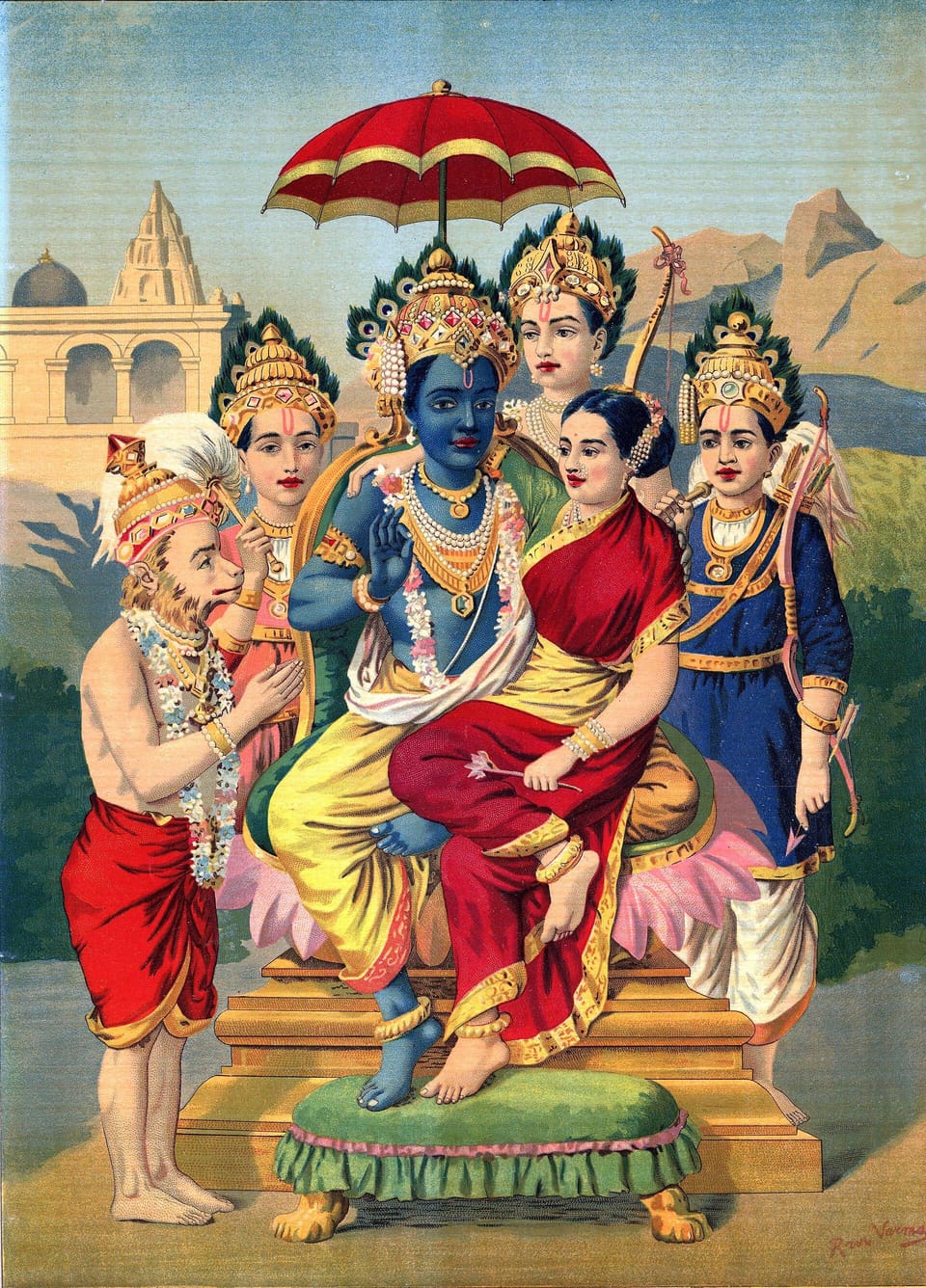
Shri Ram
श्रीरामశ్రీరాముడుஸ்ரீராமர்
Also known as: Rama · Ramchandra · Raghunath · Raghupati · Raghav · Dasharathi · Sita Ram · Kodandarama · Maryada Purushottam · Ramar
Shri Ram is the seventh avatar of Vishnu, the prince of Ayodhya whose life is told in the Ramayana. Devotees worship him with Sita, Lakshman and Hanuman as Maryada Purushottam, the ideal of dharma, and celebrate him on Ram Navami, Dussehra and Diwali.
- Festivals
- Ram Navami · Diwali (Lakshmi Puja) · Dussehra (Vijayadashami)
Texts for Shri Ram
The story
Ram was born on the ninth day of the bright half of Chaitra, the eldest son of King Dasharatha of Ayodhya and Queen Kausalya. He learned the scriptures and archery from the sages Vasishtha and Vishvamitra. At King Janaka's court he broke Shiva's great bow and married Sita. On the eve of his coronation, his father was bound to keep an old promise to Queen Kaikeyi. Ram gave up the throne without a word of complaint and went to the forest for fourteen years with Sita and his brother Lakshman.
In the forest the demon-king Ravana carried Sita away to Lanka. With Hanuman, Sugriva and the vanara army, Ram built a bridge across the sea, defeated Ravana and brought Sita back. Dussehra remembers this victory. When he came home to Ayodhya, people lit rows of lamps to welcome him, and this is one of the stories behind Diwali.
Valmiki told his story in Sanskrit in the Ramayana, and poets retold it in many Indian languages. Kamban wrote it in Tamil, and in Telugu there are the Ranganatha and Molla Ramayanas. Goswami Tulsidas wrote the Ramcharitmanas in Awadhi, and his hymn 'Shri Ramchandra Kripalu', from the Vinaya Patrika, is sung in many homes. People still say Ram Rajya, the reign of Ram, when they mean fair and kind rule.