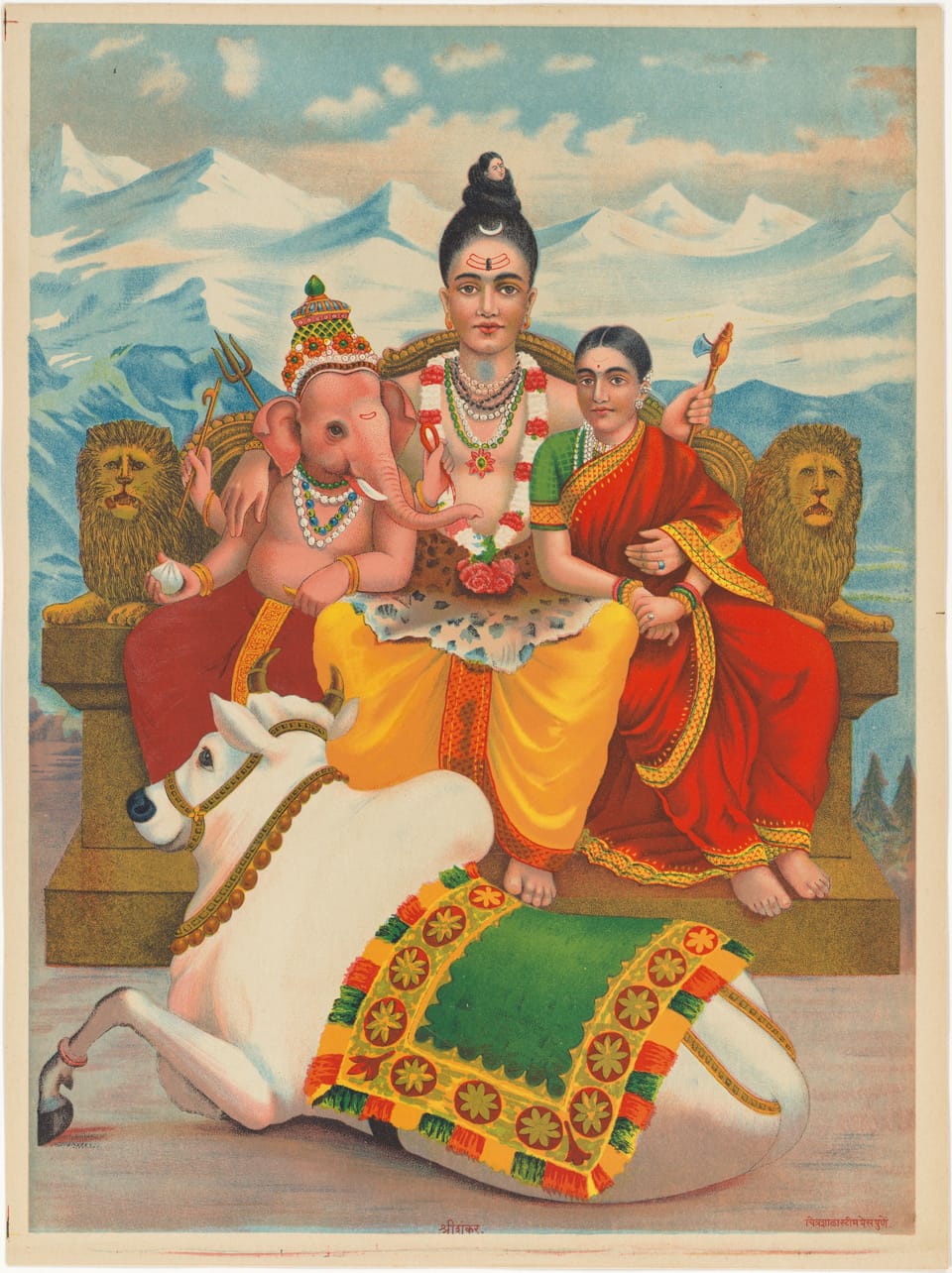
Shiva
शिवశివుడుசிவன்
Also known as: Mahadev · Bholenath · Shankar · Mahesh · Rudra · Neelkanth · Shambhu · Sadashiva · Vishwanath · Nataraja
Shiva is Mahadev, worshipped as the Shivalinga and as the ash-smeared yogi of Mount Kailash. He is called Bholenath because he is easily pleased, and devotees pray to him on Mondays, through the month of Shravan and on the night of Maha Shivratri.
- Day of worship
- Monday
- Festivals
- Maha Shivratri
Texts for Shiva
Stotra 2
- Shiva Tandava Stotram 7 min The Shiva Tandava Stotram is a Sanskrit hymn describing Shiva's fierce cosmic dance, the Tandava, and tradition attributes it to Ravana, king of Lanka. It has 15 shlokas followed by 2 phalashruti verses, in a fast metre that imitates the beat of Shiva's damaru. Tradition holds it especially fruitful on Mondays and at Pradosha, the evening twilight. 17 verses · Attributed to Ravana, king of Lanka
- Shiv Panchakshar Stotram 3 min Shiv Panchakshar Stotram is a Sanskrit hymn of five verses built on the five syllables of the mantra "Na-Mah Shi-Va-Ya", and tradition attributes it to Adi Shankaracharya. Each verse praises Shiva and salutes him as one syllable in turn (Na, Ma, Shi, Va, Ya), and a closing phalashruti says those who recite it reach Shiva's abode. It is sung at abhishekam, on Mondays and on Maha Shivratri. 6 verses · Adi Shankaracharya (per tradition)
The story
In the Vedas he is Rudra, a fierce god who also heals. The Mahamrityunjaya Mantra calls him Tryambaka, the three-eyed one. Over time Rudra came to be called Shiva, which means 'the auspicious one'. For his devotees he is the Supreme God. He sits in meditation as the great yogi, and he also dances as Nataraja.
The Puranas tell that when the gods and asuras churned the Ocean of Milk, the first thing to rise was a deadly poison, halahala, strong enough to burn every world. Shiva drank it to save creation. Parvati held it in his throat, and his throat turned blue. So he is called Neelkanth, the blue-throated one. Many say this is why devotees pour cool water and milk over the Shivalinga.
He wears the crescent moon and the river Ganga in his matted hair, snakes as ornaments and sacred ash on his body. As Ardhanarishvara he is half Shiva and half Parvati. Their sons are Ganesh and Kartikeya. In every Shiva temple his bull Nandi sits facing him.
He is called Bholenath because he asks for very little: a bilva leaf, a lota of water, and "Om Namah Shivaya" said with a true heart. Pilgrims travel to his twelve Jyotirlingas, from Kedarnath in the Himalayas to Rameshwaram in the south, and to Kashi, where he is worshipped as Vishwanath.